The practice of communications is changing, and most professionals in the field are feeling this shift first-hand. The power of communications increasingly plays a central role in influencing politics, global public health, and warfare. However, communications departments are still too often siloed into a corner, generating press releases and producing content without a seat in the boardroom.
A parallel trend in the sector, and the focus of this article, is the democratization of artificial intelligence tools, sometimes described as the potential Fourth Industrial Revolution.
According to a recent survey published by Axios, three out of four PR professionals are now incorporating generative AI into their workflows. As more communicators rely on AI, the priority is how to equip teams with the expertise to use it effectively, responsibly, and without outsourcing their judgment to generative AI models.
At Research for Purpose, we have implemented AI solutions for various international organizations.
The following trends outline practical learnings in terms of today’s opportunities and risks for communicators. The most important principle we stress in our AI trainings is clear:
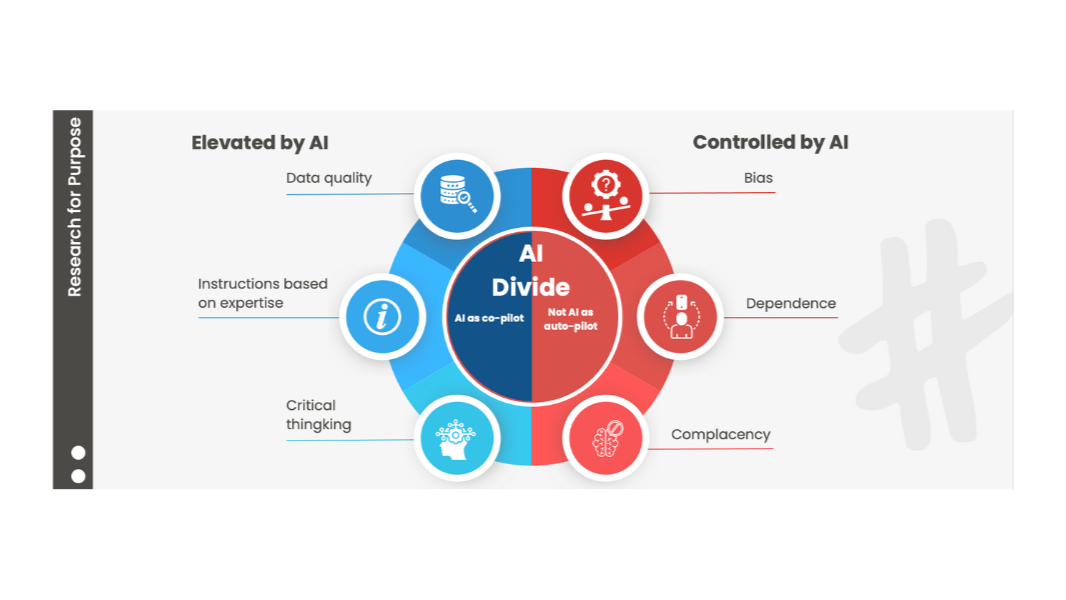
“AI should serve as a co-pilot, not an autopilot”
In terms of benefits for communicators, we are already experiencing the significant impact of AI.
First, it can save us time by handling routine tasks we used to do ourselves. Think about proofreading tasks or voiceovers for videos.
Second, the intentional, strategic use of AI applications can increase the quality of our outputs and help us better target our audiences. AI, for example, enables the measurement of topics and sentiment with greater depth, quality, accuracy, and speed than was previously possible using tools and analysts only two years ago. Another concrete example is the integration of multilingual applications for international organizations, such as emergency messaging. Lastly, we can build AI agents with specific personas to test messages or simulate a crisis.
Third, AI can be combined with automation to create new or more efficient workflows. We have already implemented several such use cases. For example, an organization can automate the analysis and reporting of insights. It can link these insights to a content creation workflow that is informed by multiple data sources such as media trends, best performing content, communications strategy documents, and industry research. You can also use all of this to inform your AI assistant, grounded in institutional tone and with the flexibility for humans to set the goals, define the story angle, provide real examples, define the target audience, and so on. All these applications have become feasible and cost-effective. These types of transformations are driving the shift in our industry: embedding AI into communications systems and workflows.
The success of such applications, however, is not a given. Without clear objectives and human-inthe-loop design, AI outputs are likely to become counterproductive (if not harmful) to an organization. Critical thinking, data quality, and subject-matter expertise are the irreplaceable pillars of effective and responsible use of AI.
As with any other powerful tools, the spread of AI access can be empowering. However, significant risks emerge from our experience in guiding organizations during their AI journey. I will focus on complacency and the adoption of AI without sufficient understanding of the technology.
From our experience, the everyday use of AI often leads to some degree of complacency. Skipping the scoping and review process while relying blindly on generative AI is a mistake that can happen to anyone. Complacency leads to mistakes that can threaten a person’s job or damage an organization’s reputation. For example, we came across examples of report recommendations, copied from generative AI applications without review, that are harmful to children.
The issue is that not all mistakes made through the adoption of AI are easy to identify. For this reason, it is critical to understand how generative AI actually works. For example, generative AI tools do not think logically. They mimic complex human language, resembling human intelligence, but they don’t understand the information. They predict words, images, or sounds based on patterns in vast datasets, which means they can produce outputs that are convincing but yet inaccurate. When generative AI is not used responsibly, communicators can undermine the organization’s (or individual’s) reputation and the very thing they want to build with effective communication: trust.
Of course, external risks are as important, forcing organizations and individuals to protect themselves. From a corporate perspective, it is clear that disinformation campaigns, amplified by AI, can cause significant business and reputational damage.
AI can be powerful but remains a tool. Used as a co-pilot, it can help us work smarter and reach wider audiences. Left on autopilot, it can erode quality, distort truth, and damage credibility.
The real challenge for organizations is not only technical but cultural: deciding how we want to use AI to improve the way we communicate. What we cannot afford to lose, even in an age of rapid automation, is our most reliable safeguard: critical thinking.
Specific use case
IWe developed an AI-powered platform for an international organization, enabling them not only to understand trending issues through AI analysis and to measure their reputation in near-real time, but also create conversational AI trained to improve how this organization tailors campaign messaging across audiences. Using AI-generated personas that reflect different values, concerns, and communication styles, the team can brainstorm with AI outputs on how to adapt its content to policymakers, young professionals, or local communities.
The system can generate variations of messages in different formats and repurpose it for multiple channels, while drawing on the organization’s strategy documents, branding guidelines, and top-performing past content. Built-in quality assurance and human review ensure outputs remain accurate and credible, making the process both faster and more targeted.
By Remy Smida, Founder of Research for Purposen.