
1. Context and challenge
UNICEF country offices receive community feedback through many channels at once. These include hotlines, RapidPro and U-Report, radio call-ins, community meetings and field surveys run on KoboToolbox. During the COVID-19 response in South Asia, this feedback was compiled manually, so it was slow to consolidate and hard to set against what people were saying online. In Mozambique, the country office needed to understand community concerns faster than its monthly reporting cycle allowed.
Both offices faced the same problem. Feedback was being collected, but the analysis took so long that concerns and rumours had often shifted before a response could be designed.
2. Our role
Research for Purpose designed, built and operates i-Hear-U, UNICEF’s AI-powered social and community listening platform. We are responsible for the platform architecture, the AI classification models, the integration with data collection tools the offices already used, and training for country office teams. For the South Asia Regional Office in Kathmandu, we also produced the regular community insight analyses that informed its social and behaviour change work.
3. What we did
Our work began in 2021 with the COVID-19 Insight Brief. It brought together feedback from hotlines, RapidPro, television and radio, community engagement events and partner meetings, and it scored each concern by spread and health threat using a risk communication model we developed. From 2022, we moved this process into i-Hear-U, starting in Nepal, so that offline feedback and online conversation could be read side by side.
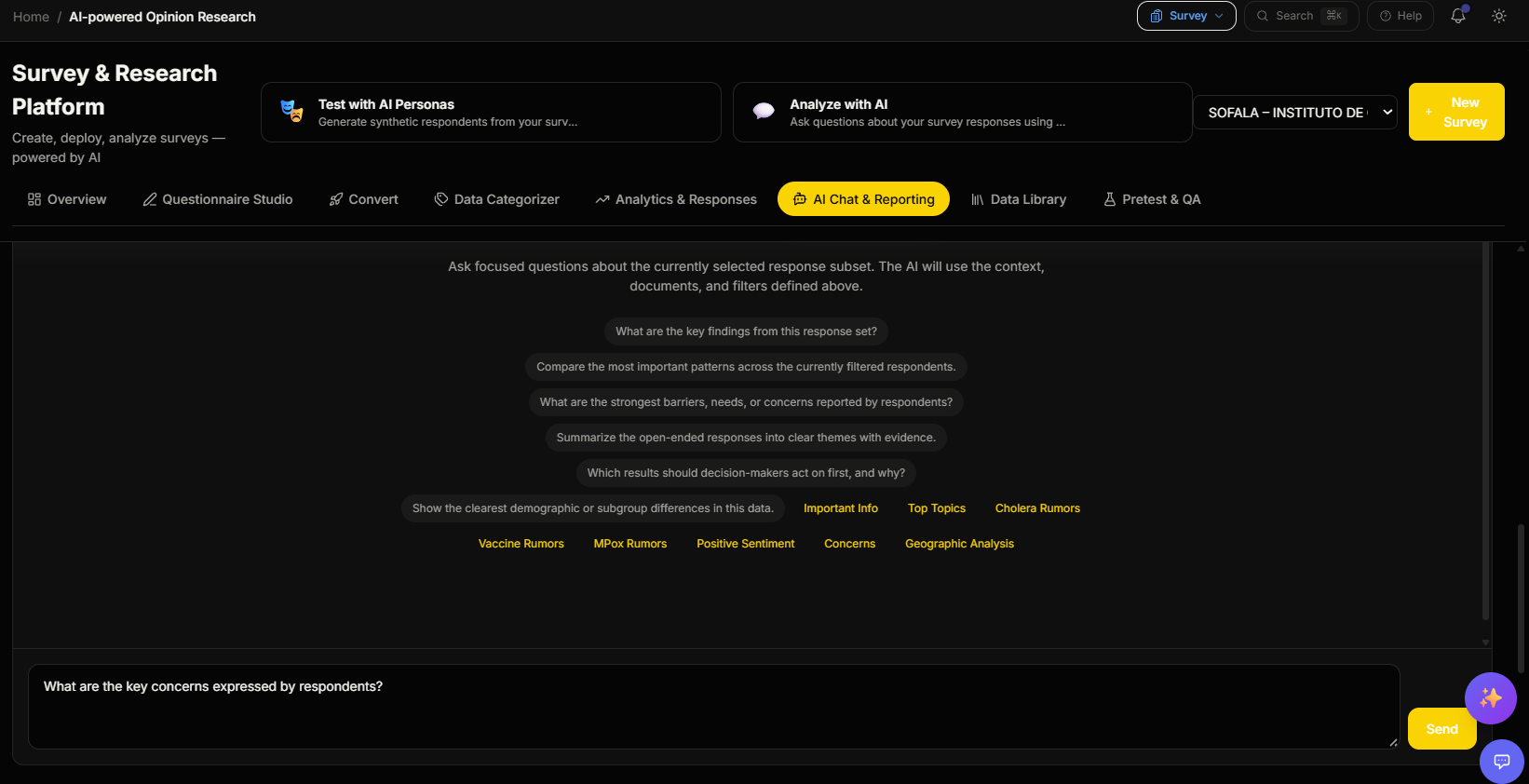
In Mozambique the office uses the platform for community feedback only, so we connected i-Hear-U directly to KoboToolbox through its API. Submissions, open-ended answers included, now reach the analysis layer without being re-entered. The AI categorises each response by issue, concern, barrier, rumour, geography and audience group. Analysts then validate the results against human coding before anything is reported. Staff can also ask the chat assistant plain-language questions about their own dataset.
Each dataset is visible only to the users who own it. This matters because feedback often contains information that is sensitive for protection.
4. Results
The Mozambique office moved its community feedback reporting from a monthly to a weekly cycle. Across the platform, AI detection accuracy reached 88.9% when validated against human-coded datasets, and UNICEF staff ran close to 1,000 queries through the chat assistant in a single year. The system that started in Nepal is now used by more than 20 UNICEF offices.
We connected to tools that field teams already used, so adopting the system did not require any change to how data was collected. Analysts stayed responsible for validation and interpretation, which gave programme teams confidence in the figures. The main lesson is that speed decides whether feedback leads to accountability. A weekly cycle lets an office respond while a concern is still live.